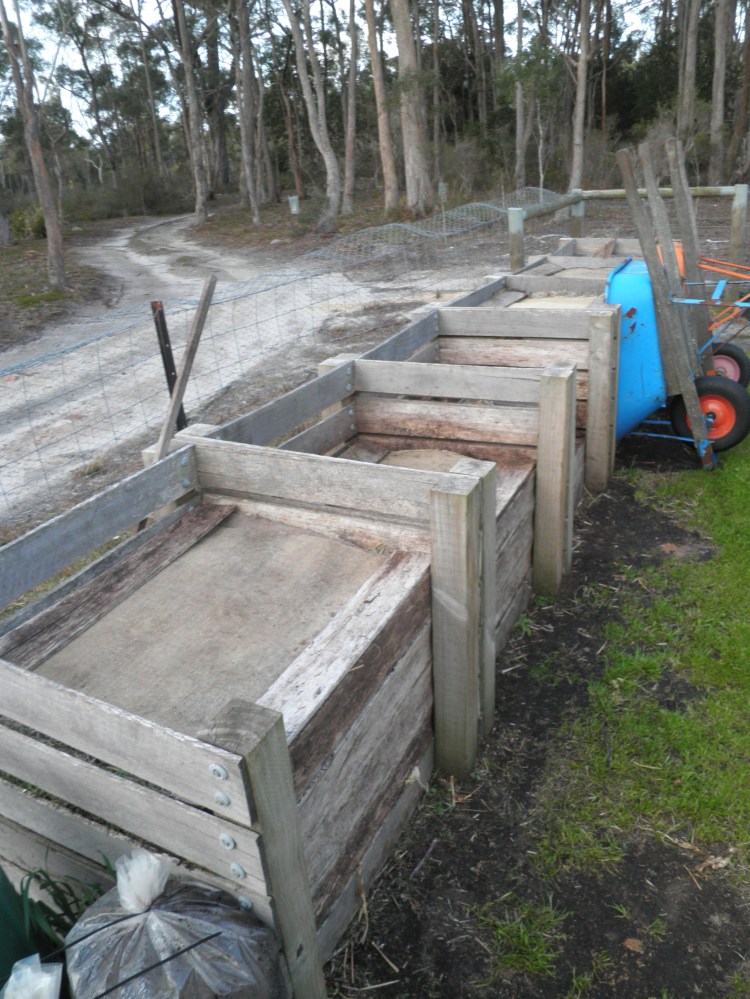
When we have an open day visitors often ask about how we make compost so here is a summary of our method. There are lots of ways to make compost but we use hot aerobic composting which kills off unwanted bugs and weeds. It mustn’t get too hot as that will kill all the good bugs too!! Generally speaking you need a pile of about a cubic metre in size to generate enough heat. We have five, roughly one square metre bins made from green milled hardwood. They are four years old now and still going strong, we expect the slats will need replacing in another three of four years.
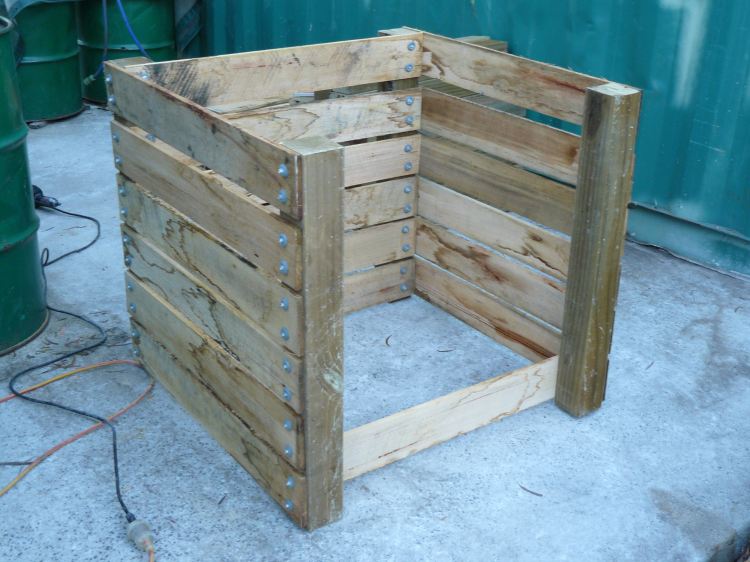
We had 180cm fence palings cut at Goshen Sawmill, which we then cut down to 90cm for the final job. We attached them using whatever screws we had on hand to 90x90mm posts cut to 90cm long, putting only one paling on the front to allow access. As the pile grows we just slip more palings in to hold it back. This way the palings can be removed to turn the mix and shovel out the finished compost.
We always start the pile with yarrow leaves as they have a high concentration of sulfur, potassium, copper, phosphates, nitrates, copper, and potash. These are beneficial nutrients to have in your compost and we always start a new pile by putting a few yarrow leaves in the bottom. Traditionally this is thought to speed up the decomposition process and who are we to argue with tradition.
There are arguments about whether to layer the compost or not. We always layer it and it works for us. We find that the green waste layer generates more heat in the pile if it is not mixed in with the other ingredients. We put a few generous handfuls of straw in next, then a shovel or two of bio char, a couple of shovels of sawdust, then four or five inches of waste mint mulch, then four or five inches of green waste from the garden, perhaps leaves from brassicas that are finished or in spring there’s lots of grass clippings which get really hot quite quickly. We might throw in a few handfuls of kelp chips or whatever we have on hand. We are aiming to make it as nutrient dense as we can so use whatever is handy, sometimes we throw in some mushroom compost, it all depends on what is available at the time. You can also add a compost accelerant that speeds decomposition but they cost about $10 and don’t go far so this makes it more expensive. We never put food scraps in the compost as it attracts vermin, the scraps all go into the worm farm.
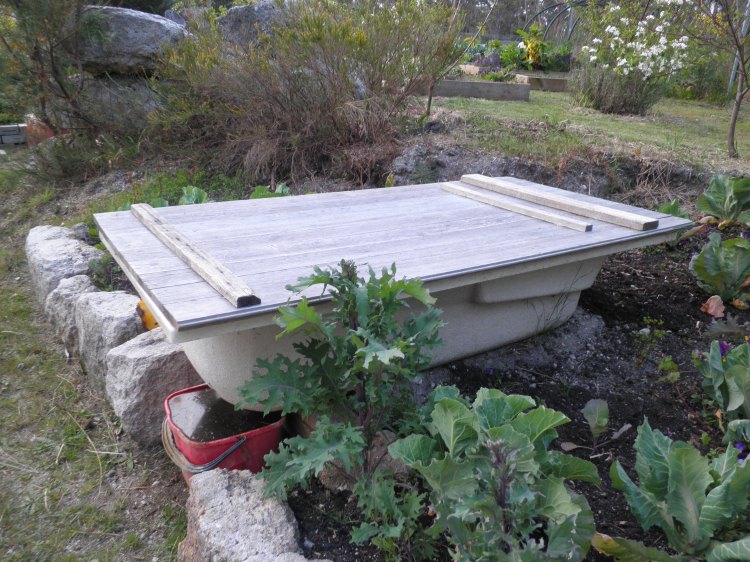
The worm farm is in an old bathtub. The worm wee comes out the plughole into a bucket so it can be diluted and watered on the garden. The castings (that’s a scientific word for worm poop), can be removed when it’s full and either added to the compost of dug into a bed.
Back to composting, once the pile is built we aerate it by poking holes in it with a garden stake all the way to the bottom. This is to ensure it doesn’t become anaerobic. If your compost is slimy or smells bad it means that is needs oxygen, hence the air holes. Make sure you do the air holes each time you turn. Then we cover it with a piece of Persian carpet cut to fit the bins. If you don’t have Persian carpet I am sure any carpet will do.
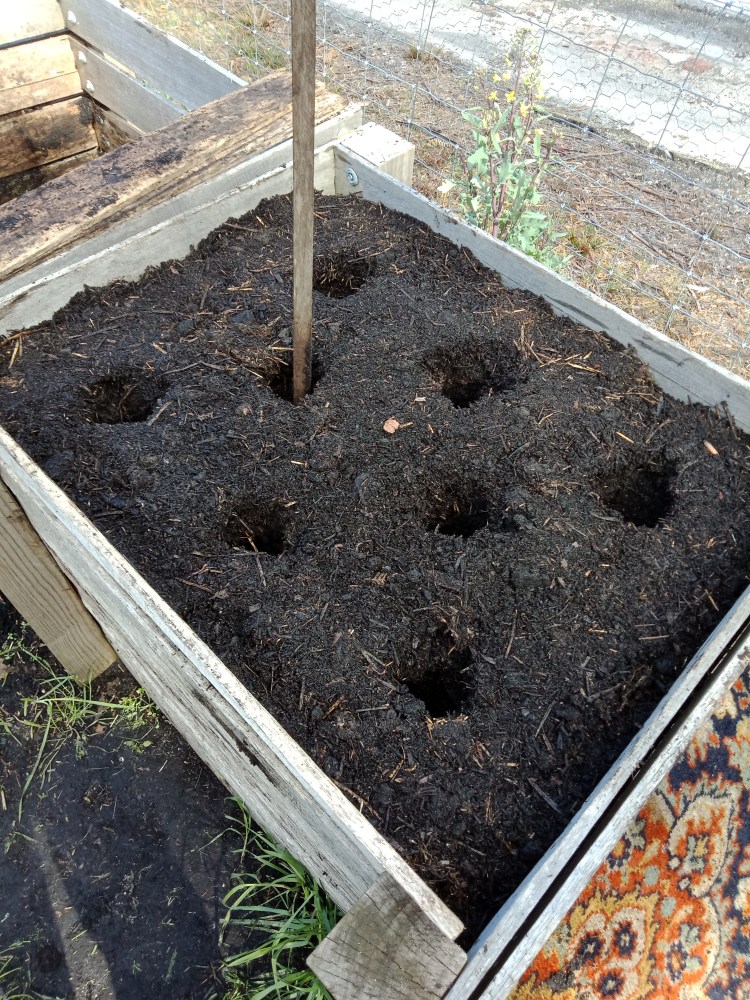
Next comes the fun part, turning!! We like to think we do this every week, but in reality it is every few weeks depending on what else is happening in the garden. The pile goes down very quickly in the beginning and you can keep adding to it. We shovel from the first bin, into the next and so on until all five are full. By the time it gets to the fifth bin it is ready to go on the garden. It still generates heat in the second bin but by the time it gets to the third it is cold. By the fifth bin there are usually a few nice juicy worms in there. As the pile keeps reducing as it decomposes you can just keep turning it from one bin to the next until it is full otherwise the fifth bin will only have about a quarter of the volume that you started with. We also use the compost to make compost tea, see a previous post on how to make this, click this link and scroll down: Making Compost Tea
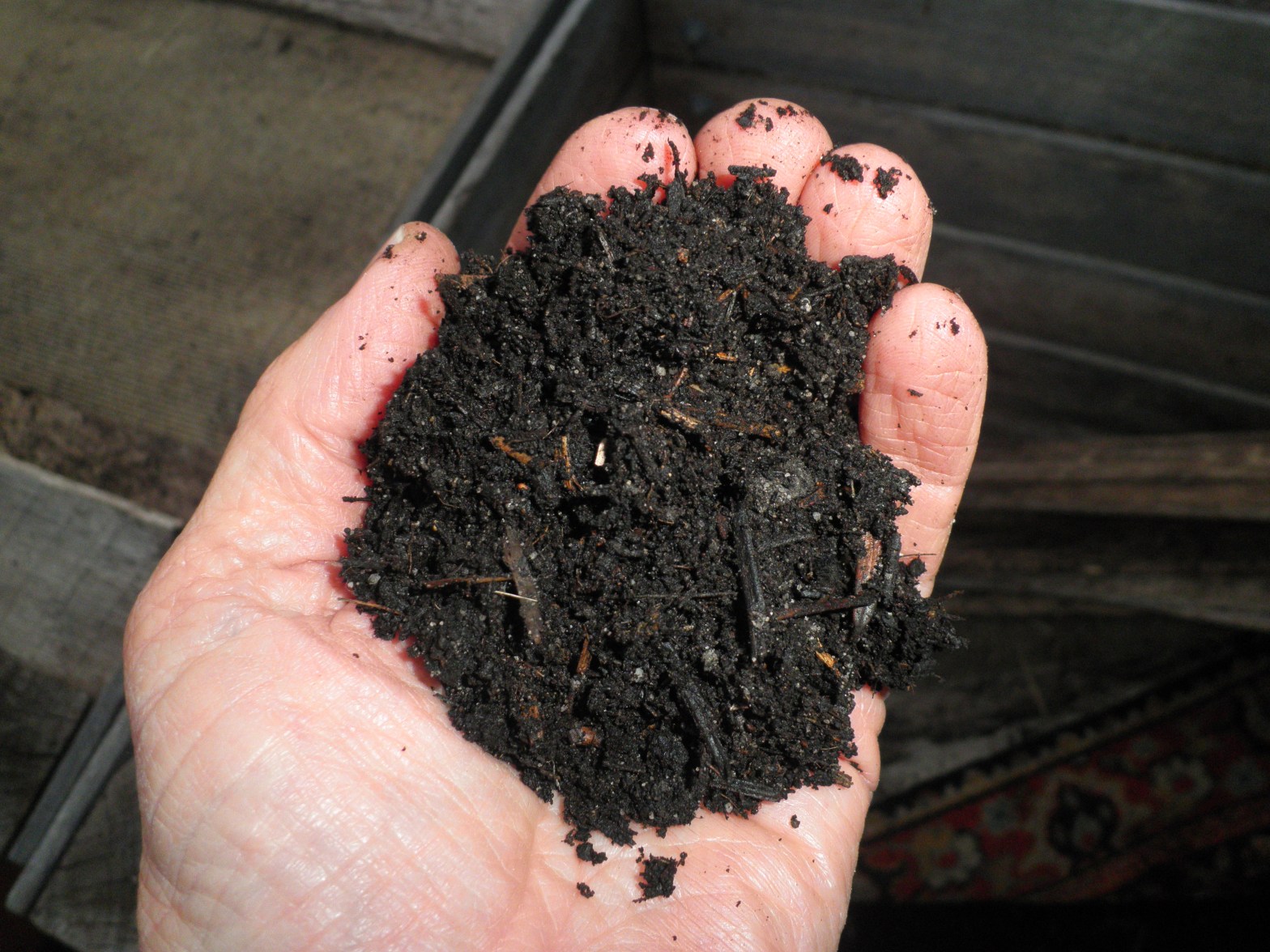
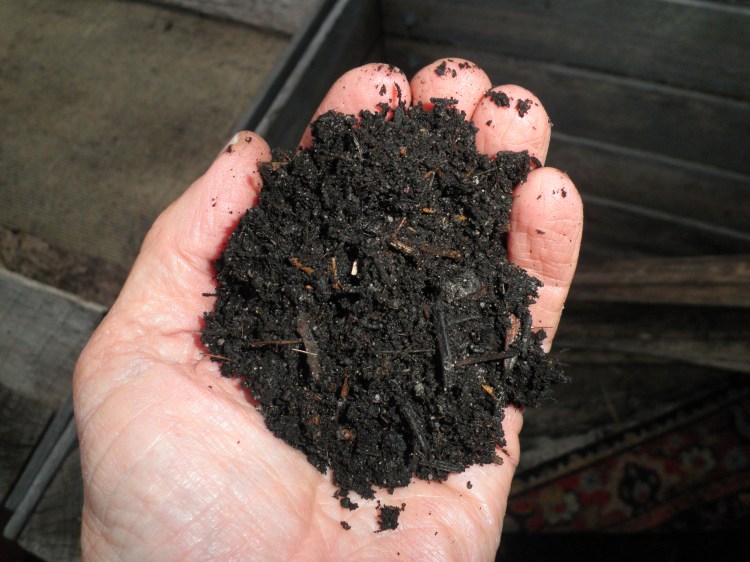
Here is the finished product . . . smells sweet, is friable and tastes great on toast (that was a joke, please don’t eat the compost).
 Banksia Hollow
The homemade compost bins look great!
Stop making compost look good enough to eat!
I love this. Thanks Nev
Now I know what we can do when we are ready 🙂